
Purchase orders in.
Draft orders out.
Stop wasting time manually decoding messy purchase orders. AutoPO accepts orders in any format—PDFs, Excel files, or even snapshots of handwritten sheets—then automatically cross-references your Shopify catalog to create ready-to-go draft orders. You only step in when something needs a second look.
- Hunt down the attachment in your inbox
- Decode messy PDFs, spreadsheets, or scans
- Cross-reference every SKU manually
- Audit prices line by line
- Re-add totals to catch human error
- Finally, re-key the whole thing into Shopify
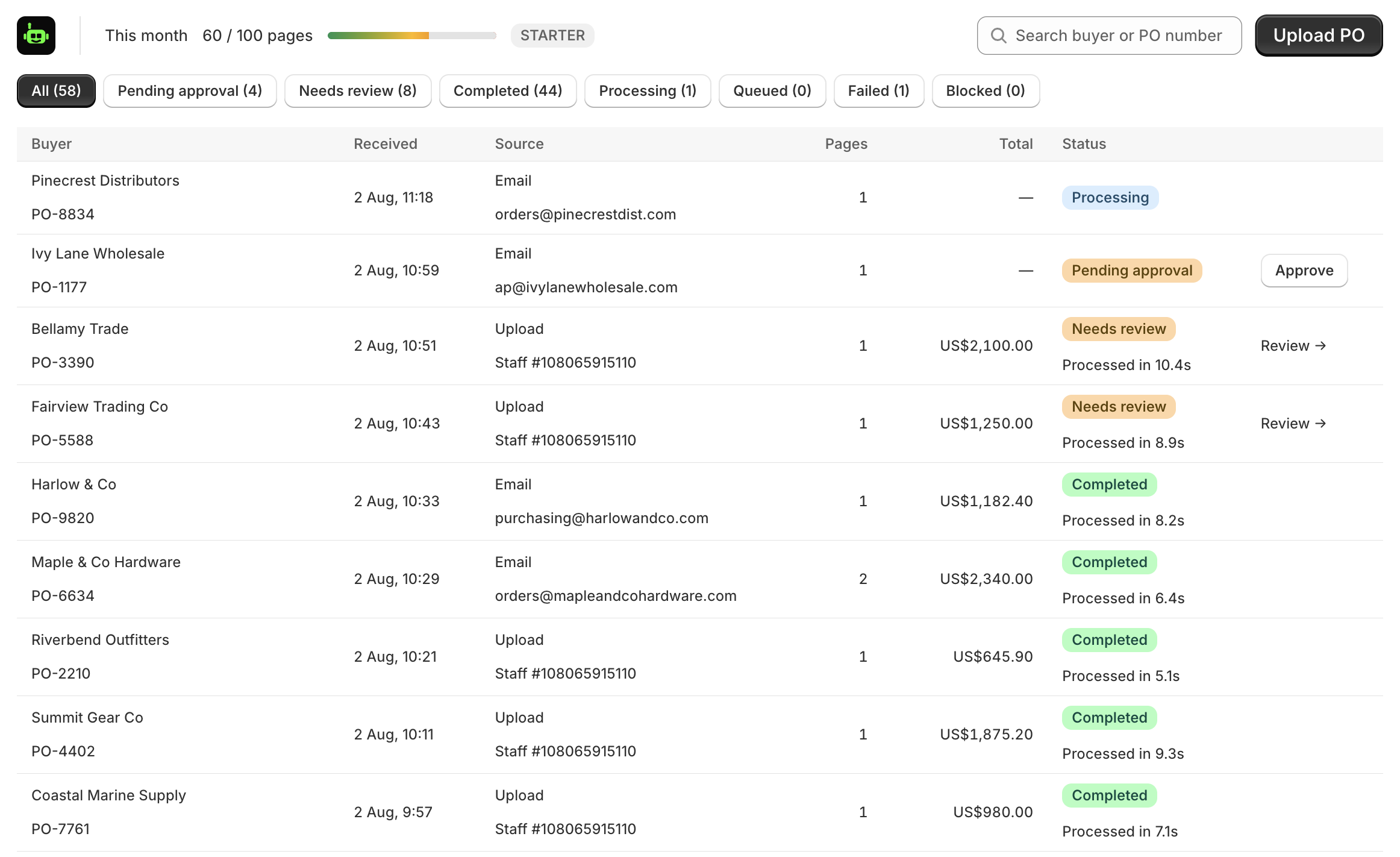
- Forward the email to your AutoPO address — or drag the file in
- Clean orders arrive in Shopify as draft orders, priced against your catalog
- You only open the ones AutoPO couldn't verify
Four steps, one pass.
It arrives
Email forward or manual upload. Unrecognized senders are held for approval — only buyers you've allowlisted go straight through.
Parsed by powerful LLMs
Line items, SKUs, quantities, unit prices, buyer address, and the total the document itself states.
Math has to close
The lines are re-added and compared to that stated total, the order size is sanity-checked, and the document's currency is checked against your store.
Prices verified
Every price checked against your Shopify catalog, or a pricing agreement on file for that buyer.
Whatever shows up.
Powered by AI, not rigid templates. Because it actually reads and understands the document, the format doesn't matter—even if it's a photo of a handwritten order.
Built-in protection against under-billing and fraud.
Incoming purchase orders never override your live pricing. If a PO attempts to slip in a lower price without a valid pricing agreement on file, AutoPO stops it in its tracks and flags it for review. Your Shopify catalog remains the single source of truth, ensuring unauthorized discounts or calculation tricks never quietly slip through.
Documents and extracted order data are only ever used to process that order — never sold, shared, or used for anything else. The draft order itself lives in your own Shopify store.
Whitelist the buyers you trust for email-in orders. Unknown senders are held for one-time approval; blacklisted senders are rejected outright.
AutoPO reads the currency a PO is written in. A currency your store already prices in (via Shopify Markets) is used as-is — your real configured price, not a guessed conversion. Any other currency is held for a human. Never a live-rate conversion, either way.
Consistent intelligence at every tier,
built to scale.
You get our full AI capability on every single plan. We have plans designed to scale as your business grows. All prices in USD.
Try for free — 10 pages, one time- Email or upload purchase orders in the app
- Automatic draft order creation
- Manual review for anything that doesn't reconcile
- Custom payment-term validation — up to 25 rules
- +Advanced SKU mapping & fuzzy matching
- +Buyer-specific learning from your corrections
- +Up to 75 buyer payment rules
- +Stock awareness across every warehouse location
- +Up to 200 buyer payment rules
- +Shopify Flow triggers
- +ERP / accounting integrations, on request
- +Up to 500 buyer payment rules
- +Priority processing queue
- +EDI/XML document parsing
- +Unlimited buyer payment rules
A page counts as up to 25 line items. Documents with more than 25 items, or unstructured formats like XML, are billed based on each 25-item increment.
Automate your next PO instead of typing it.
Install in your Shopify Admin and try the full pipeline free — 10 pages, no card required. Upload your first purchase order now, or upgrade anytime to forward them straight from your inbox.